Wolverine, Gulo gulo.
I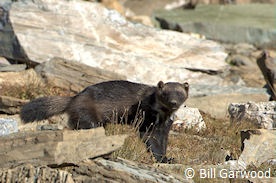 n 1758, Linnaeus assigned the Latin name, Gulo gulo, to the Eurasian wolverine. The Latin “gula” and “gulosus” translate to the English words “throat” and “gluttonous”, respectively. The North American form was previously thought to be a different species (Gulo luscus), but has since been lumped with its Old World counterpart. Degerbol (1935), and later works by Kurten and Rausch (1959) strongly suggested that Eurasian and North American populations of wolverine were conspecific. Recently, Tomasik and Cook (2005) and Frances (2008) further demonstrated this fact through molecular (mitochondrial DNA) work. Early work by Kurten and Rausch (1959) lumped all North American wolverine into a single race, G. gulo luscus. Heptner and Naumov (1974) delineated 3 subspecies of wolverine in Eurasia, while Hall (1981) listed 4 subspecies of wolverine throughout North America. More recent mtDNA analyses (Kyle and Strobeck 2001, Tomasik and Cook 2005, Frances 2008) seems to refute the occurrence of a unique subspecies on the Kenai Peninsula in Alaska (thus potentially negating G. g. katschemakensis as a valid subspecies). Copeland and Whitman (2003) listed only two subspecies worldwide, with G. g. gulo the single Eurasian race and G. g. luscus occurring in North America.
<< Back to Species Account Overview
_______________________________________________
Literature Cited
Copeland, J.P. and J.S. Whitman. 2003. Wolverine (Gulo gulo). Pages 672-682 in Wild Mammals of North America: Biology, Management, and Economics. G.A. Feldhamer, B.C. Thompson, and J.A. Chapman, editors. The Johns Hopkins University Press. Baltimore, Maryland USA.
Degerbol, M. 1935. Report of the mammals collected by the fifth Thule Expedition to Arctic North America; Zoology. I. Mammals. Report of the fifth Thule Expedition, 1921-1922. 2:1-67.
Frances, J. 2008. Spatial genetic structure and demographic history of wolverine in North America with an emphasis on northern peripheral populations. Unpublished MSc thesis. University of New Mexico, Albuquerque, USA.
Hall, E.R. 1981. The Mammals of North America. Wiley-Interscience, New York. USA.
Heptner, V.G. and N.P. Naumov. 1974. Die Saugetiere der Sowjetunion. Volume 2. Seekuhe und Raubtiere. Jena, Fisher Verlag.
Kurten, B. and R.L. Rausch. 1959. Biometric comparisons between North American and European mammals. I. A comparison between Alaskan and Fennoscandian wolverine (Gulo gulo Linnaeus). Acta Arctica 11:1-21.
Kyle, C.J. and C. Strobeck. 2001. Genetic structure of North American wolverine (Gulo gulo) populations. Molecular Ecology 10:337-347.
Tomasik, E. and J.A. Cook. 2005. Mitochondrial phylogeography and conservation genetics of wolverine (Gulo gulo) in Northwestern North America. Journal of Mammalogy 86:386-396.
 Follow